A guide by Wild Ceylon, a private safari company, not the Transit Home. මෙය ඇත් අතුරු සෙවණේ වෙබ් අඩවිය නොවේ.
Udawalawe Elephant Transit Home: Feeding Times & Ticket Prices

Elephant Transit Home, run by the wildlife department, in Udawalawe town: feeds every day at about 10:30, 14:30 and 18:00. Foreign adults about US$6, paid in rupees at its counter; Sri Lankans pay less. Its own number: 047 223 2147. Directions
Plan a safari day with a feed Plan a ride that stops here
Or ask on WhatsApp · Our Udawalawe safaris. Safari day: tick the 10:30 feed in the planner, after a morning drive; the wait is free. Other drives? Ask us. Ride: from Ella, or from the coast; the stop is priced in. You pay the Transit Home at its counter.
Feeding times, tickets and honest tips for the Udawalawe Elephant Transit Home, how it differs from Pinnawala, and how to fit a feed around your safari.

Quick facts
- Run by
- The wildlife department, not us
- Feeds you can watch
- Usually 10:30, 14:30 and 18:00
- Ticket
- About US$6 a foreign adult, cash in rupees
- Where
- Udawalawe town, 15 min from the park gate
- Time to allow
- About an hour
- Best with
- A morning safari, then the 10:30 feed
On this page
The Elephant Transit Home in Udawalawe town, often called the Udawalawe elephant orphanage, raises orphaned wild elephant calves until they're old enough to go back to the wild. Three times a day, usually at about 10:30, 14:30 and 18:00, you can watch dozens of calves come in for their milk from a covered stand. It costs a few dollars, takes about an hour and fits neatly around a safari in the park, 15 minutes up the road.
A quick word on who we are. Wild Ceylon is a private safari company: we don't run the Transit Home or sell its tickets. It's run by Sri Lanka's Department of Wildlife Conservation, and its own number, on its main Google Maps listing, is 047 223 2147 (+94 47 223 2147 from abroad). How its Google listings came to link to our site is explained at the end of this guide. We can take you there on a safari day. The times and prices below were checked in October 2026 against a recent photo of its entrance sign and visitors' reports, and the times again with a call to the Transit Home.
Feeding times, and which feed to choose
Three feeds are open to visitors, usually at about 10:30, 14:30 and 18:00. A few visitors put the last one at 18:30, so allow for that. Many websites still give the four-feed timetable that ran until around 2020. There's usually no early-morning or midday feed for visitors now, so don't plan around one, and check the times on the day.
It's open every day, Poya days included, but you can only get in around the feeds. The ticket counter opens about 15 to 30 minutes before each one, and between feeds there's nothing to see. Each feed lasts about half an hour, sometimes a little longer.
Which one to pick:
- 10:30 is the natural choice after a morning safari.
- 14:30 is the hottest, but the stand is roofed. It suits anyone staying nearby, or arriving from the coast at lunchtime.
- 18:00 is cooler, in softer light, with mosquitoes for company. It clashes with an afternoon safari, which ends at the park gate at 18:00.
Weekends, Poya (full-moon) holidays and Sri Lankan school holidays bring crowds of local visitors, so a weekday feed is usually calmer.
Tickets and what to bring
Foreign visitors pay about US$5 plus 18% VAT an adult, charged in rupees: about LKR 2,000, or roughly US$6. Children aged 6 to 12 pay about US$3 plus VAT, and Sri Lankans pay much less. These are the prices visitors reported up to October 2026; they change from time to time, so treat them as a guide.
- Buy at the entrance. Tickets are sold only at the Transit Home's own counter. It isn't in the wildlife department's online permit system, and there's nothing to book.
- No park ticket needed. Its entrance is in town, not behind the park gate.
- Bring cash in rupees (there's no ATM on site), and some small notes if you'd like to leave a donation.
- Bring water, a hat, insect repellent for the evening feed, and a zoom lens or binoculars. The calves are about 15 to 20 metres from the stand.
If you're on a safari day with us, our estimate already includes your national park tickets, but not the Transit Home's: you pay that at its counter.
Where it is and how to get there
The Transit Home is in Udawalawe town, about 300 metres up C.P. De Silva Road from the town junction on the Udawalawe–Thanamalwila road (B427), beside the reservoir on the western edge of the national park. Its Sinhala name is ඇත් අතුරු සෙවණ (Ath Athuru Sevana). There's a car park by the entrance, and directions in Google Maps.
- From the park's main gate it's 9 km, about 15 minutes by car.
- Heading to the south coast (Mirissa, Tangalle, Galle), it's on your way and adds only a couple of minutes.
- Heading to Ella, it's a detour of about half an hour, back the way you came.
- From Tissamaharama or Yala, it's about an hour and a half by road, so it pairs best with an Udawalawe safari rather than a Yala one.
- Staying in Udawalawe town, it's a short walk or tuk-tuk ride from most guesthouses.
On the road from the park gate you may see wild elephants waiting at the park's fence for food. Feeding them is illegal: watch from the car and drive on.
Fitting it into a safari day
The easy way is a morning safari, then the 10:30 feed. On a day with the feed, your drive ends at 09:30, half an hour earlier than a usual morning drive. By the time you're back in the car and in town, it'll be about 10:00, half an hour before the feed starts. Seats aren't reserved, so being early helps, especially with small children. Lunch comes after the feed.
Here's a typical day from Ella to the beach, with the feed:
Without the feed, you'd reach Mirissa about an hour earlier. Heading the other way, to Ella, the feed adds up to an hour and a half, because the Transit Home is a detour, as it is towards Arugam Bay or Tissamaharama.
An afternoon safari is harder to pair. The 14:30 feed falls during the drive. The 18:00 feed comes at its end, as you leave the park. You can catch the 10:30 feed first, then have lunch in town and reach the gate by 13:45. From Ella or the coast, that means leaving three to four hours earlier, with a long wait in town. Ask us if you'd like to, and we'll plan it with you; a morning drive, or a night in Udawalawe town, is easier.
After a long morning in the park, until 12:00, the 10:30 feed is over. The 14:30 one fits after lunch in town: ask us, and we'll plan it with you.
Staying near the park makes it easy. From a hotel in Udawalawe town, the Transit Home is a short walk or tuk-tuk ride away, so you can catch the 14:30 or 18:00 feed on your own. After a morning drive from the town, ask to be dropped at the Transit Home instead of your hotel. With a night there, you can also take an afternoon drive when you arrive and a morning drive the next day, then the 10:30 feed before you move on: we plan two drives like that on request.
To add the 10:30 feed to a morning safari day, tick it under "Day & group" in our planner (rather than adding Udawalawe town as a stop), or ask us on WhatsApp. Your plan then shows the drive ending at 09:30, the feed, lunch after it and when you'll really arrive. Your driver waits for it at no extra charge: you pay only the Transit Home's ticket, in rupees at its counter. For a feed with any other drive, ask us. Feeding times can change at short notice, so it's worth checking them on the day.
Plan Ella to
Ask us on WhatsApp to plan a day with a feed or Email us about a feed at the Elephant Transit Home
Not doing a safari? We can simply drive you between Ella and the coast, with a stop in Udawalawe town for the 10:30 feed. The stop is in the planner's price, and you pay only the Transit Home's ticket at its counter. Starting from somewhere else? Change your pickup in the planner, and we'll check the time still fits the feed.
- Ella to
Udawalawe town to Pickup 07:30 · in Udawalawe town 10:00–11:00 · Mirissa about 12:45Mirissa - Mirissa to
Udawalawe town to Pickup 08:30 · in Udawalawe town 10:15–11:15 · Ella about 13:45Ella
For the safari itself, from morning or afternoon drives to what you're likely to see, read our Udawalawe National Park guide and the Udawalawe safari page.
What a visit is like
Arrive early and find a place on the stand, a few rows of covered concrete steps behind a barrier. There are no reserved seats, and small children can struggle to see over the adults in front, so the earlier you come, the better. The stand is stepped, so wheelchair access is limited.
Then the gates open, and the calves come in a few at a time, trotting straight for the keepers, who give them milk through a tube and funnel. Each one gulps its share in seconds and wanders off to browse on leafy branches or push its neighbours around, while the next ones barge in. With 40 to 60 calves coming through, expect chaos, and a lot of charm.
Before or after a feed, look into the Elephant Knowledge Walk, the information centre and small museum by the entrance, reopened in 2024 with displays in Sinhala, Tamil and English. It's good on how elephants live and why calves end up here. Some exhibits are skeletons and preserved remains, which you may want to know about if you have small children. There's a souvenir shop too, and cafés by the entrance.
Photos are allowed from the stand. Please don't use a flash, and don't bring a drone.
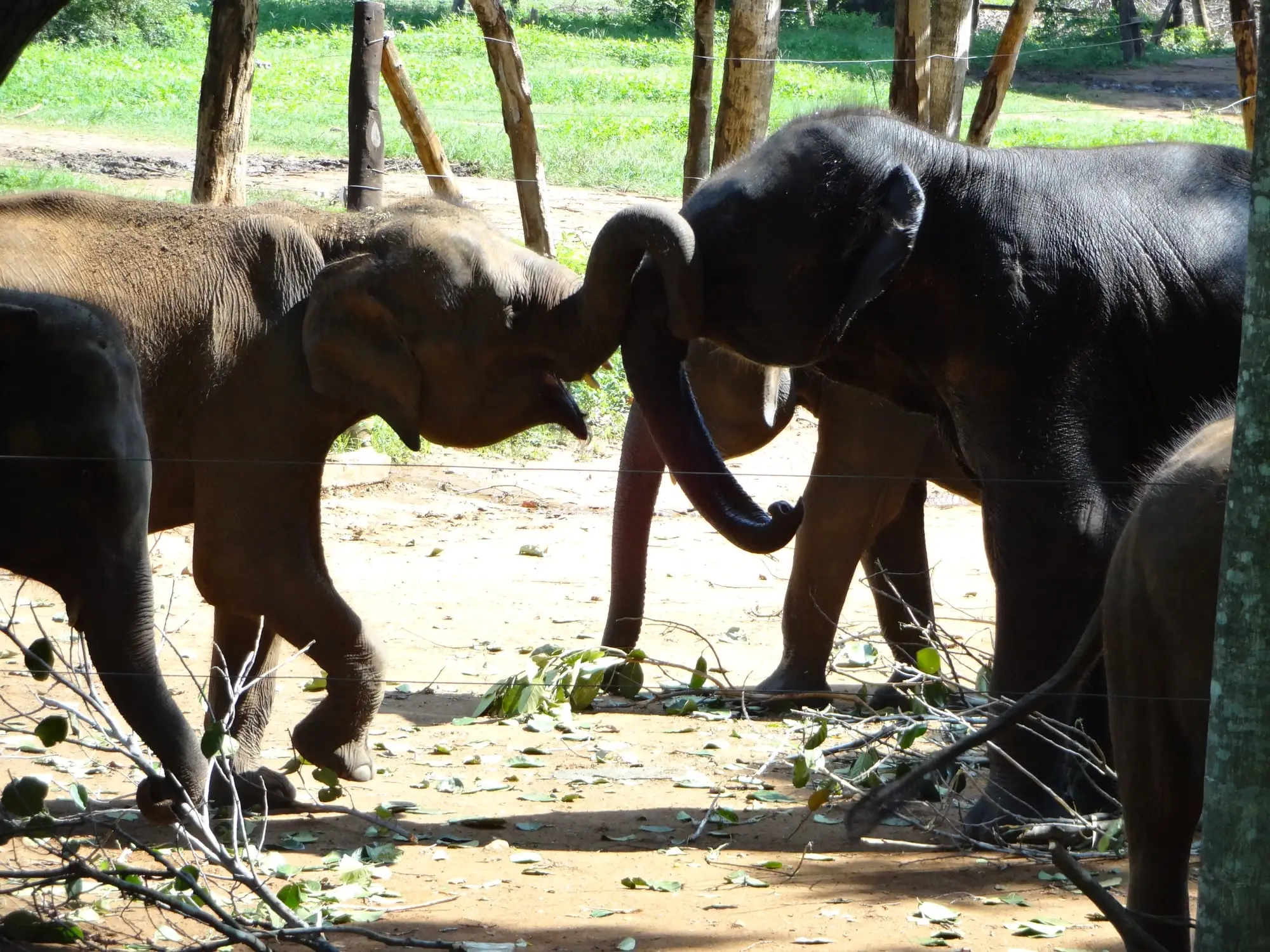
Two calves greet each other with their trunks in the Transit Home's yard.
How the calves get here, and what happens to them
Most calves are orphaned by the conflict between people and elephants. Their mothers are killed, or herds are chased off crops and the calves are left behind. Others fall into wells, pits or canals, get caught in snares or are found injured or starving. About two-thirds arrive before their first birthday, many of them weak, and sadly a lot of the youngest don't survive their first weeks.
The rest are raised on milk formula, fed several times a day and once at night. Contact with people is kept to feeding and veterinary care, on purpose: the aim is a wild elephant that keeps away from people, not a tame one. Between feeds the calves roam the Transit Home's grounds and the edge of the park, where wild elephants sometimes visit.
At about five to seven years old, they're released in small groups that have grown up together, mostly into Udawalawe National Park, and sometimes into other parks. About a third wear a radio or GPS collar for their first years, and the Transit Home's staff follow them closely at first. By August 2025, 186 had been released; the 26th group went out in July 2025. A 2025 study found that about one in ten died within two years of release, and at least 18 released females have since had calves in the wild.
So a few of the elephants you meet on a safari in Udawalawe may well have grown up here.
Is it ethical?
It's the kinder way to see young elephants in Sri Lanka. There are no rides, no bathing and no touching, contact with people is kept to a minimum, and the whole point is to put the calves back in the wild. That sets it well apart from places that keep elephants for rides, shows or bathing.
It isn't perfect, though, and we'd rather you heard it from us. The feeds can be crowded and noisy: about 240,000 people visited in 2024. Keepers carry sticks to keep order around the milk, and for years some visitors have reported calves being hit with them; since 2024 a few have also reported electric prods. Others saw only light taps, or nothing at all. We can't verify these reports, but there are enough of them to mention.
If you see something that worries you, tell the staff there, report it on the environment ministry's 24-hour wildlife hotline, 1995, and say what you saw in an honest review. Tell us at Wild Ceylon too: we'd like to know. Watching quietly, without shouting to the calves or pushing to the barrier, helps the keepers as well.
Elephant Transit Home or Pinnawala?
Both get called "the elephant orphanage", which causes a lot of confusion.
- Pinnawala, near Kegalle between Colombo and Kandy, opened as an orphanage in 1975 but hasn't taken in wild orphans for more than a decade. It's now a captive herd of about 65 elephants, many born there, walked to the river twice a day, with paid sessions to join them in the water.
- The Elephant Transit Home takes in orphaned calves from around the country to release them.
We'd choose the Transit Home every time. Our guide to where to see wild elephants has more on Pinnawala, rides and bathing, and on the best parks for wild herds in each month.
Supporting the Transit Home
You can leave a donation on site. We couldn't find a fostering or sponsorship scheme open to visitors today: companies such as Dilmah sponsor calves, but an older scheme for individuals no longer seems to run. If you'd like to help more, ask at the counter. We know of no volunteering programme either, which is as it should be for elephants meant to stay wild.
Good to know
Is this the Elephant Transit Home's official website?
No. We're Wild Ceylon, a private safari company: we don't run the Transit Home or sell its tickets. It's run by Sri Lanka's Department of Wildlife Conservation (www.dwc.gov.lk) and, as far as we found in October 2026, has no working website of its own. Its own number, on its main Google Maps listing, is 047 223 2147 (+94 47 223 2147 from abroad). Google's listings for the Transit Home link to our Udawalawe safari page, because we suggested our page as their website while it has no website of its own. If the department asks, we'll ask Google to change them the same day. අපි Wild Ceylon, පෞද්ගලික සෆාරි සමාගමකි; ඇත් අතුරු සෙවණ නොවේ. එය පවත්වාගෙන යන්නේ වනජීවී සංරක්ෂණ දෙපාර්තමේන්තුවයි. ඇත් අතුරු සෙවණේ දුරකථන අංකය 047 223 2147.
What time is feeding at the Elephant Transit Home?
Three feeds are open to visitors, usually at about 10:30, 14:30 and 18:00, and each lasts about half an hour. Some visitors put the last one at 18:30, and older guides still print the four-feed timetable that ended around 2020. Times change, so check on the day.
How much is the ticket, and do I need to book?
About US$5 plus VAT for a foreign adult, paid in rupees (about LKR 2,000), and about US$3 plus VAT for children aged 6 to 12. You pay at the Transit Home's own counter just before a feed. There's no online booking, and you don't need a national park ticket.
Can you touch or feed the baby elephants?
No. You watch from a covered stand behind a barrier while the keepers feed the calves. Tours that promise you can feed them or interact with them are wrong. Contact with people is kept to a minimum on purpose, so the calves stay wild enough to be released.
Is it the same as the elephant orphanage at Pinnawala?
No. Pinnawala, near Kegalle, keeps a captive herd that breeds there and sells bathing sessions, and it hasn't taken in wild orphans for more than a decade. The Transit Home, which some people call the Udawalawe elephant orphanage, raises orphans to release them into national parks.
Can we do a safari and the Transit Home on the same day?
Yes. With the feed, your morning drive in Udawalawe National Park ends at 09:30, and you reach the Transit Home, on the way to the south coast, about half an hour before the 10:30 feed starts. Tick it under "Day & group" in our planner and your plan includes it: the driver waits at no extra charge. After an afternoon drive or a long morning, ask us.
Is it worth it if we've already seen wild elephants?
For most people, yes, as a short add-on. It takes about an hour, and you see dozens of young calves at once, far more than you'd meet on a drive, as they come in for their milk. It's a busy feeding session, though, not a wildlife encounter, and some visitors find it a little zoo-like after the wild herds.
Turn the drive into a safari day
We pick you up where you're staying, stop at the park and take you on to your next stop. Private car, private jeep, park tickets: one all-in estimate, sent on WhatsApp. No deposit, pay on the day.
Ella toKeep planning
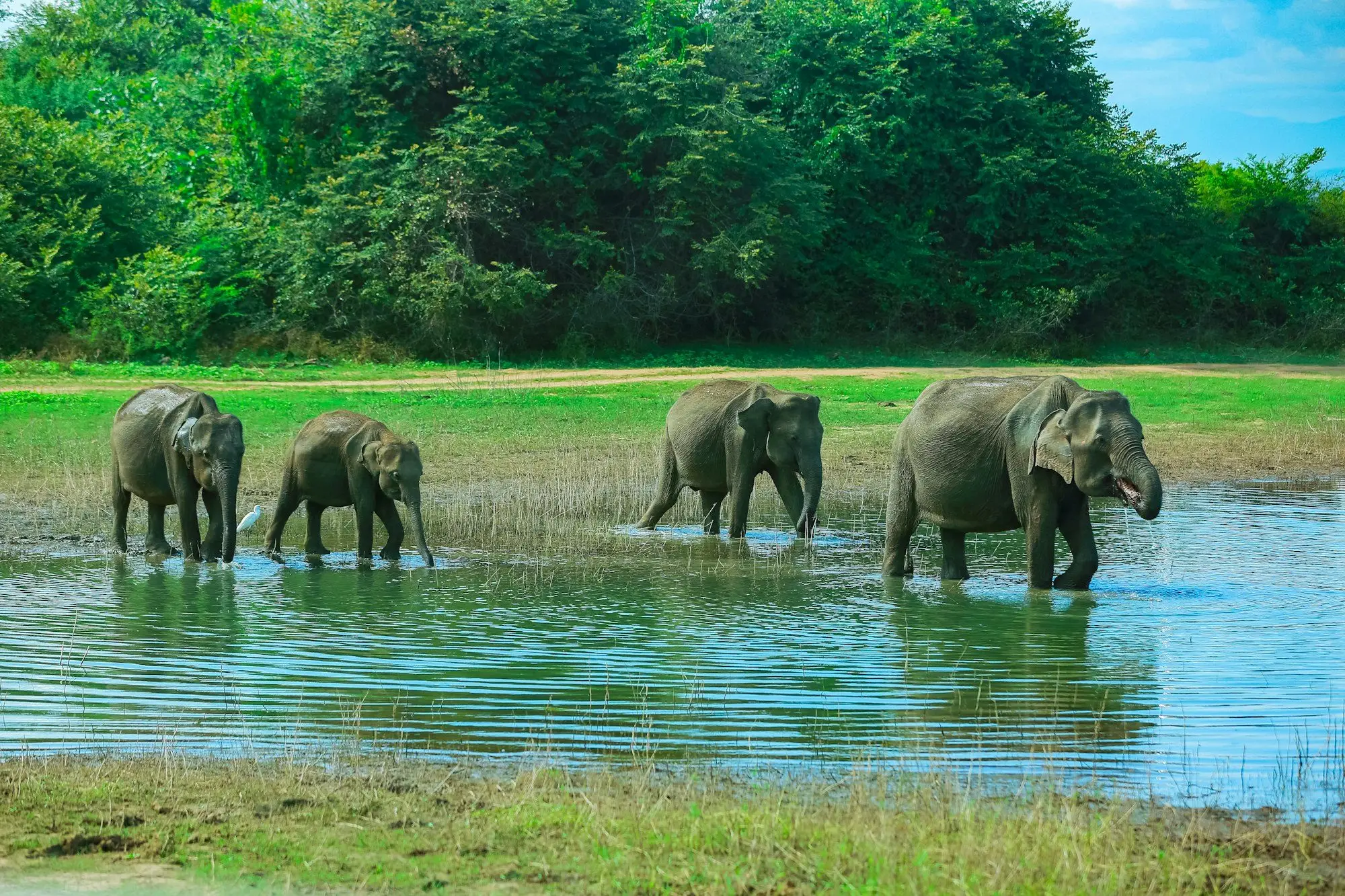

Udawalawe National Park Guide: Elephants, Fees & Tips
Plan an Udawalawe safari: elephant herds, morning vs afternoon drives, entrance fees, the Elephant Transit Home and easy trips from Ella or Mirissa.
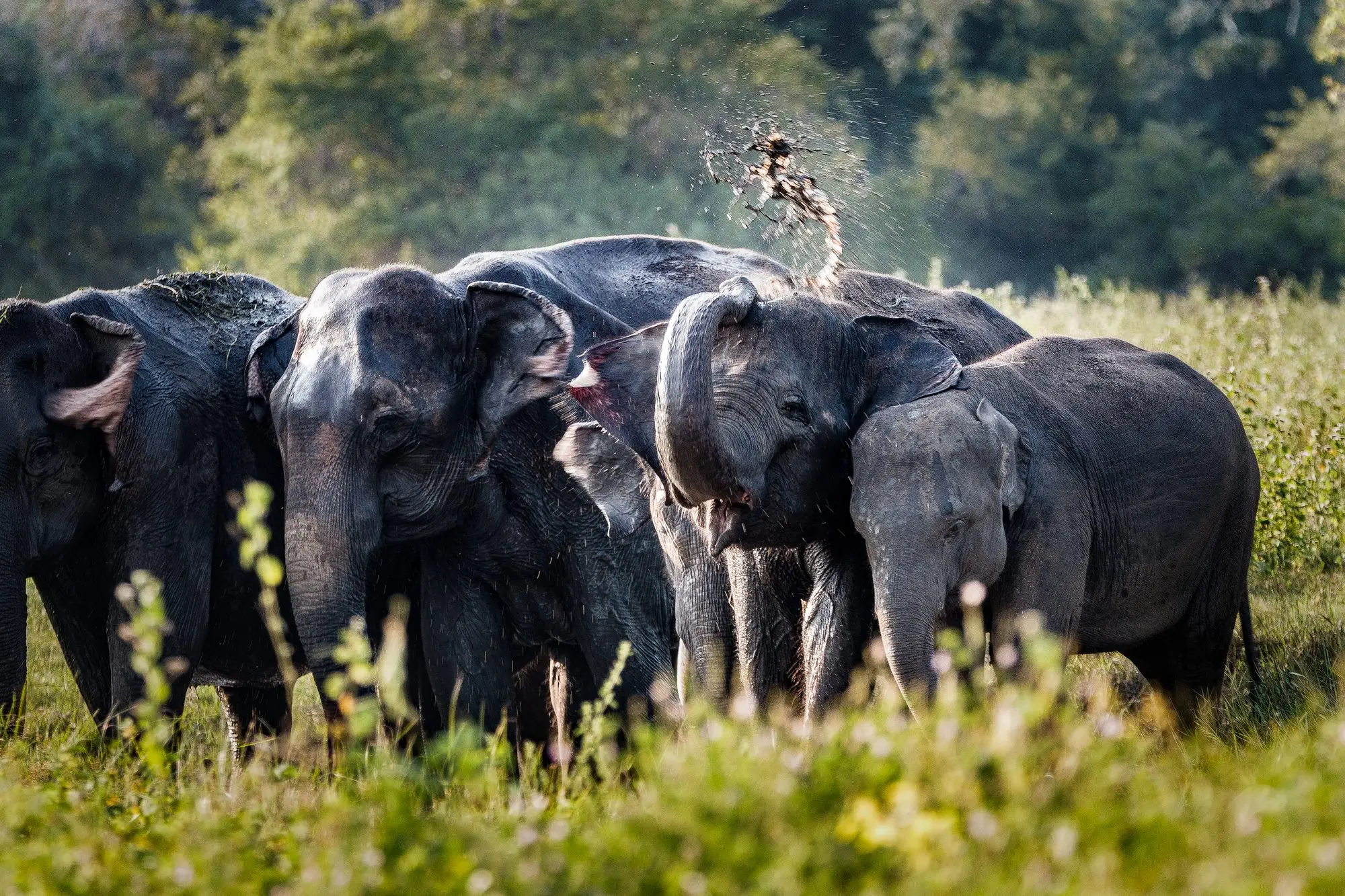
Where to See Wild Elephants in Sri Lanka, Month by Month
Minneriya or Udawalawe? Where wild elephants are easiest to see each month, with honest notes on crowds, costs, drive times and what to skip.
Sri Lanka Safari Cost 2026–27: Park Fees, Jeeps & Extras
What a safari in Yala, Udawalawe, Wilpattu or Minneriya really costs: entrance fees, jeep hire, transfers, tips and the cheap-price traps to avoid.