Wilpattu National Park Guide: Leopards, Lakes & Logistics
Sri Lanka's biggest, quietest park: how Wilpattu's lakes work, leopard and sloth bear odds, gates, fees, best months and trips from Negombo or Sigiriya.


Quick facts
- Size
- Sri Lanka's largest park
- Best months
- Feb–Oct
- Leopard odds
- Possible, with few jeeps
- Main gate
- Hunuwilagama
- From Anuradhapura
- ~1 h
- Fits best
- Start or end of a trip
On this page
Wilpattu is the park for people who would rather wait quietly by a lake than sit in a line of jeeps. It's Sri Lanka's largest national park, a vast spread of dense dry-zone forest on the north-west coast dotted with natural lakes, and it sees a fraction of Yala's visitors. Leopards live here, sloth bears too, and when you find one there's a good chance it's just you, a jeep or two and the animal.
The trade-off is that Wilpattu makes you work for it. The bush is thick, the distances are long and the best areas are deep inside, so if you can possibly manage a full day, take it. The park is also far from the south, which means it fits best at the start or end of a trip: about an hour from Anuradhapura, 2½ hours from Sigiriya and roughly 3¼ to 3½ hours from Negombo and the airport.
Wilpattu at a glance
Wilpattu covers about 1,317 km², though only part of it is open to visitors. It was declared a sanctuary in 1905 and a national park in 1938, then closed for more than 14 years during the civil war, from 1988 to 2003. That long break is part of why it still feels so wild, and why its animals can be shyer of jeeps than Yala's.
The story of Sri Lanka's beginnings is set here too. According to the Mahavamsa chronicle, Prince Vijaya landed on this coast at Tambapanni, usually placed at Kudiramalai Point, in the sixth century BC. You won't see much of that on a safari, but it's something to think about while you wait for a leopard.
The villus: why Wilpattu feels different
Wilpattu is usually translated as "land of lakes", and it earns the name. Scattered through the forest are around a hundred natural lakes and tanks. The famous ones are the villus: shallow, sand-rimmed basins that fill with rain in the wet season and slowly shrink through the dry months. Most hold fresh water, but a few, such as Lunu Villu (literally "salt lake"), are brackish.
Driving Wilpattu is a rhythm of forest and clearing. You bump along narrow sandy tracks, often brick-red, through scrub so dense you can see only a few metres in. Then the trees open out around a villu: still water, a ring of short grass and pale sand, and whatever has come down to drink. Spotted deer graze at the edges, painted storks and egrets work the shallows, crocodiles drift in the middle and, if your luck is in, a leopard walks out of the tree line. Then it's back into the forest until the next one.
Names you might hear from your driver include Kumbuk Villu, shaded by big kumbuk trees and used as a rest stop; Kalli Villu, popular with cormorants, egrets and crocodiles; and Maha Pathassa Villu, a large lake ringed by thick jungle. Which ones you reach depends on time, track conditions and your driver's hunch about where the cats have been moving.
The villus also explain the seasons. In the dry months animals have fewer places to drink, so they turn up at the remaining water more predictably, which is why timing your visit matters more here than at Udawalawe.
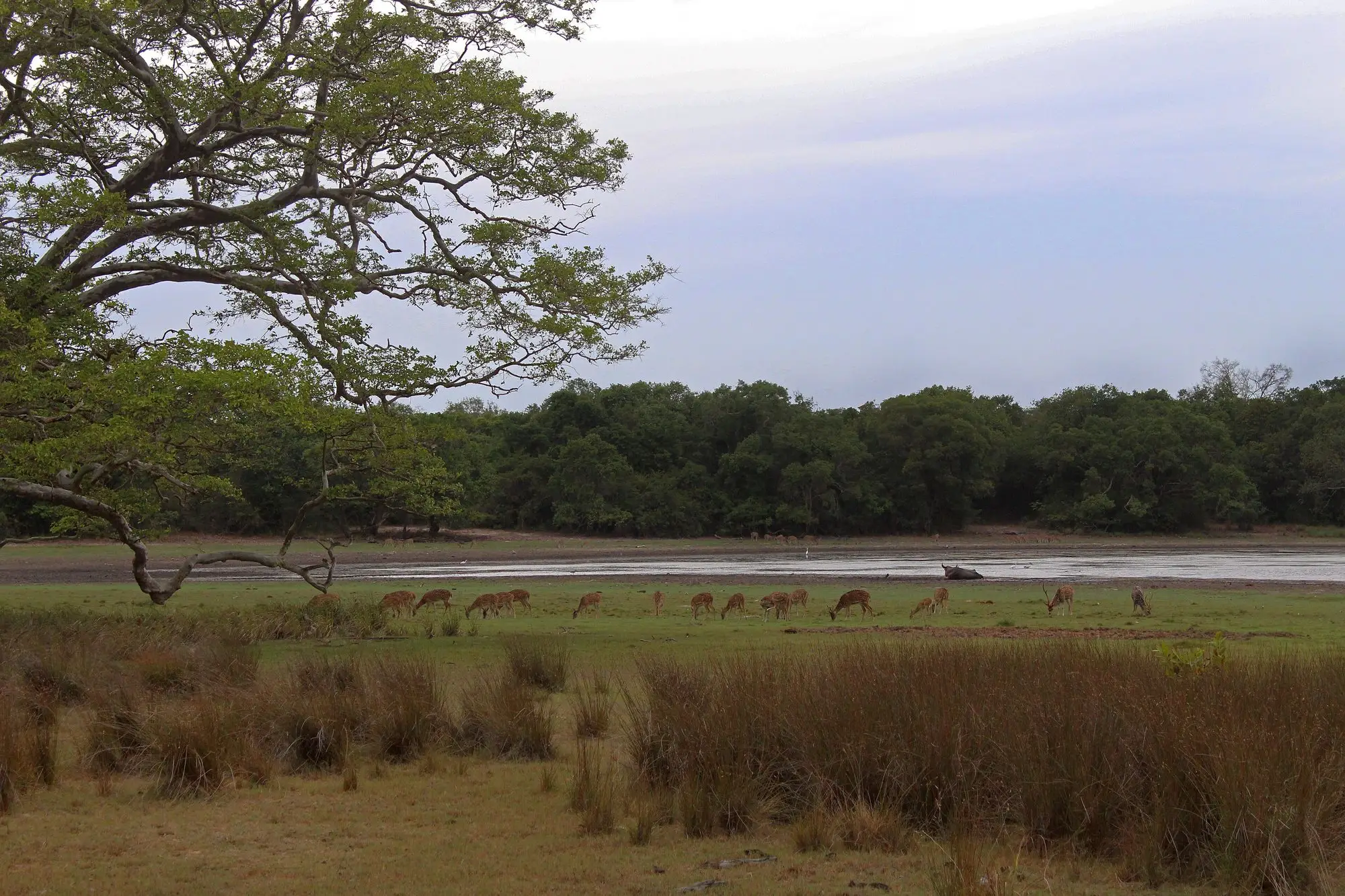
A big herd of spotted deer grazing beside a villu in Wilpattu.
Leopards, sloth bears and more
What you might see in Wilpattu
- Leopard Possible Fewer jeeps than Yala and calmer sightings, but denser bush.
- Spotted deer Very likely
- Sambar deer Likely
- Crocodile Likely
- Water buffalo Likely
- Asian elephant Possible
- Sloth bear If you're lucky
- Birds incl. painted storks & eagles Very likely
Our honest odds for a single half-day drive in a good season. Wild animals keep their own schedule, so nobody can promise a sighting.
Leopards are the headline, and Wilpattu has a healthy population: one camera-trap survey here recorded well over a hundred individual leopards. Seeing one is a possibility on any drive rather than a likelihood, because the cover is so thick. What changes is the quality of a sighting. Instead of a dozen jeeps revving for position, you'll often share it with one or two others, or nobody at all, and you can watch for as long as the leopard stays. On most days far fewer jeeps enter the whole park than queue at Yala's main gate on a busy morning.
Sloth bears are Wilpattu's other prize. They look shaggy and a little clumsy, but they move surprisingly fast, and they're most often seen early in the morning, sometimes a mother with a cub riding on her back. Count any sighting as luck.
Elephants are possible but much less common here than in Udawalawe or Yala. Spotted deer are everywhere, sambar are likely, and water buffalo and crocodiles turn up at most villus. The birdlife is excellent: painted storks, pelicans, herons, eagles and, in the forest, hornbills and junglefowl. Mongooses and monitor lizards cross the tracks regularly, and you'll hear far more than you see: peacocks shrieking, monkeys crashing through the branches, deer barking an alarm.
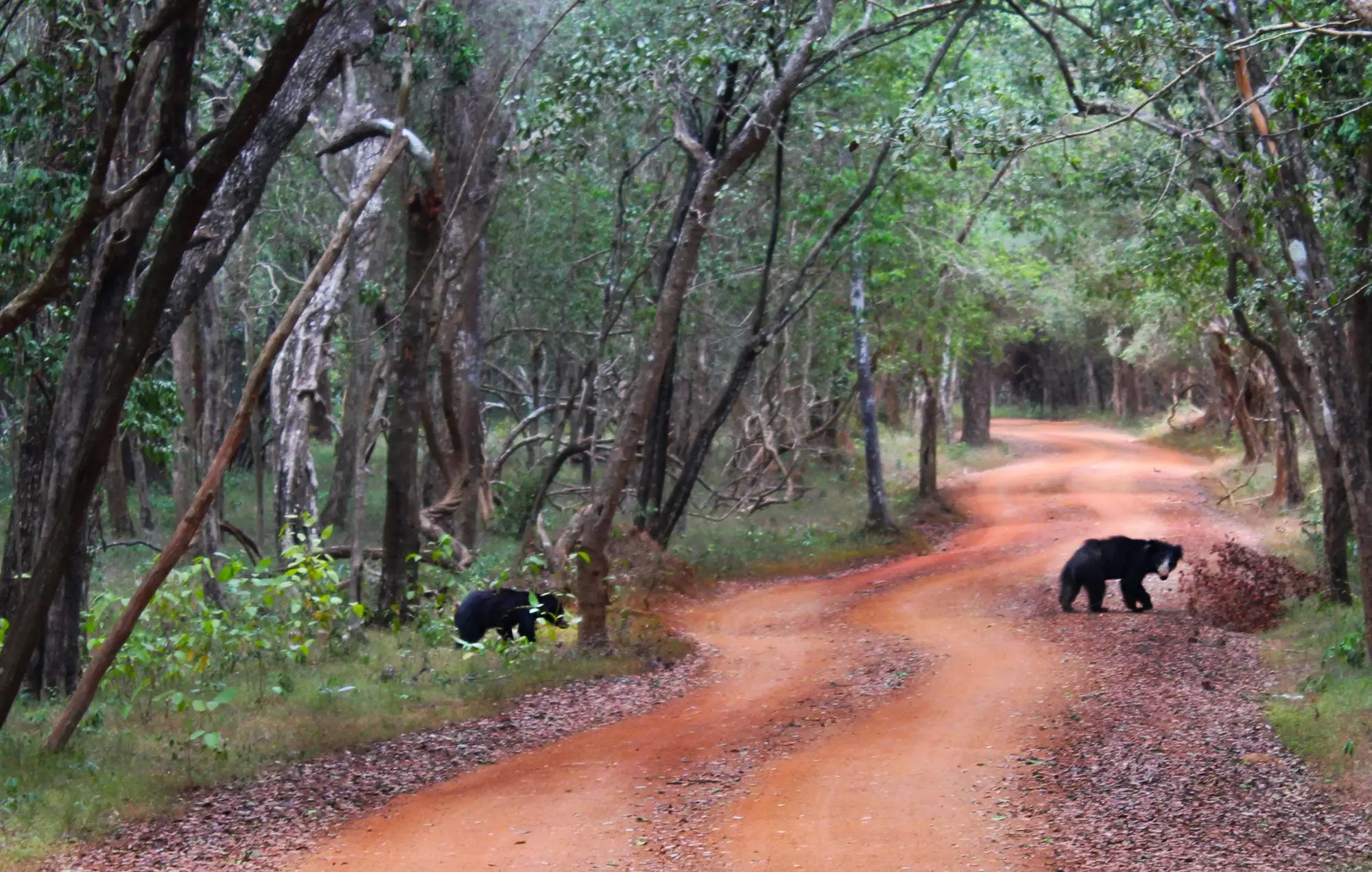
A sloth bear mother and cub crossing a red track in Wilpattu.
Wilpattu vs Yala for leopards
If you want the best odds on a single drive, Yala wins. Its leopards are more used to vehicles, and its open patches make them easier to spot. If you care about the experience as much as the tick, Wilpattu repays the gamble: fewer jeeps, longer and calmer sightings, and the feeling of real wilderness. Plenty of keen wildlife watchers do both, Wilpattu at the start of a trip and Yala at the end. Our Yala guide covers the other side of the island.
Best time to visit
The dry season, roughly February to October, is Wilpattu's prime time. As the villus shrink, animals turn up at the water more predictably and the tracks are firm. The middle of that window, from about May to September, is often the most productive, though it's also hot and dusty. February to April is greener, with fewer visitors and the odd shower.
The north-east monsoon brings the rain, from around October or November through January. Tracks turn to mud, and floods can close parts of the park, or all of it, at short notice: the whole park shut during Cyclone Ditwah in late 2025. You can still visit in the wet months, but keep your plans flexible and expect a muddier, greener park.
Wilpattu doesn't share Yala's September–October closure, so it's a good alternative if you're in the north or west while Yala's Blocks 1 and 2 are shut.
Half-day or full-day?
Half-day drives run from 06:00 to about 10:30, or from about 14:00 to 18:00. A full day runs gate to gate, 06:00 to 18:00, with lunch at one of the designated rest points inside the park. Mornings are generally better than afternoons here.
In most parks a half day is plenty. In Wilpattu, a full day earns its keep:
- Distance. The park is vast and the villus are spread out. A half day mostly covers the lakes nearer the Hunuwilagama gate, while a full day lets your driver push deeper, where fewer jeeps go.
- Patience. Leopards here often need waiting for. With a full day you can afford to sit at a promising villu for an hour.
- Value. A full-day jeep costs less than two half days, and you only pay the park ticket once.
The downside is twelve hours on bumpy tracks in the heat. If you're travelling with young children, or anyone who struggles with heat and long days, a morning half day is the kinder choice.
What a full day feels like
You're at the gate before 6 am while it's still dark, and the first hour is the best of the day: cool air, long shadows and animals still moving between the villus. Breakfast is usually a packed box eaten in the jeep beside a quiet lake. Late morning gets slower and hotter, and your driver will start working the bigger villus where animals come to drink.
Lunch is at a designated rest point, such as the shady spot at Kumbuk Villu, where you can get out and stretch your legs. The early afternoon is the sleepy part of the day, for you and the wildlife alike. From about 3 pm things wake up again, and the last couple of hours, as the light turns gold over the water, are often as good as the first. You'll be back at the gate just before 6 pm, covered in dust and very ready for dinner.
For a full day, pack properly:
- plenty of water, plus snacks and lunch (lodges near the gate usually do packed meals);
- a hat, sunscreen and a long-sleeved layer for sun and insects;
- muted clothes rather than bright colours;
- binoculars, and a camera with a decent zoom;
- a cushion if your back objects to potholes.
Photographers should know that the light at the villus is best early and late, and that you'll be shooting from the jeep on the track, so a long lens earns its place far more than a wide one.
Inside the park the usual rules apply: stay seated in the jeep, keep the noise down, skip the flash and take all your rubbish out with you.
Hunuwilagama vs Eluwankulama gate
Hunuwilagama is the main entrance and the one almost everyone uses. It's on the eastern side of the park, about an hour west of Anuradhapura, at the end of a side road of roughly 10 km off the Puttalam–Anuradhapura road. The nearest small town is Nochchiyagama. The park office and ticket counter are here, and it gives the quickest access to the area where leopards are most often seen. All our Wilpattu timings and prices assume this gate.
Eluwankulama is the western entrance, on the old Puttalam–Mannar road where it crosses the Kala Oya river. It opened to visitors in 2016 to give Kalpitiya and Puttalam a shortcut into the park, and on a map it's the closer gate if you're staying on that side. The catch is the river crossing. The causeway has flooded repeatedly: the gate was still shut months after floods in late 2019, and it closed again "until further notice" in January 2025 when the Kala Oya overflowed.
So our advice is to plan around Hunuwilagama. If you're staying in Kalpitiya and hear that Eluwankulama is open, it may save you time, but check the week you travel rather than trusting an old web page. A few lodges sit on the Eluwankulama side; if you book one, ask how they get guests into the park when that gate is closed.
Entrance fees and safari costs
Wilpattu uses the same foreigner fees as Sri Lanka's other big parks: a per-person ticket, a per-jeep charge and 18% VAT.
| Adult | US$25 |
|---|---|
| Child (6–12 years) | US$15 |
| Under 6 | Free |
| Per jeep (service + vehicle fee) | about US$11 |
| VAT on top | 18% |
- 1 adult$42
- 2 adults$72
- 2 adults + 1 child$90
- 4 adults$131
Foreigner rates for 2025–26 as reported by operators and traveller receipts, for one jeep, VAT included. Wild Ceylon estimates always include park tickets, and we confirm the exact amount before you travel.
The figures are 2025–26 foreigner rates, and we'll confirm the exact amount before you travel. You can pay at the Hunuwilagama counter or buy an e-permit in advance through the Department of Wildlife Conservation's online system; either way, your jeep driver will usually handle it.
On the open market, a private jeep with driver typically costs around US$45–60 for a half day and US$70–110 for a full day, for up to six people. Jeeps are hired at or near the gate, and lodges close to the park often have their own. If you come with us, the car from your hotel, the jeep and the tickets are all in one estimate, and your driver waits while you're in the park.
Getting there from Negombo, Colombo, Sigiriya and Anuradhapura
Driving to Wilpattu: Hunuwilagama main entrance
| From | Drive | Morning pickup | Afternoon pickup |
|---|---|---|---|
| Anuradhapura | 1 h · 40 km | 04:45 | 12:45 |
| Sigiriya | 2 h 30 · 99 km | 03:15 | 10:30 |
| Kalpitiya | 2 h 15 · 98 km | 03:30 | 11:30 |
| Negombo | 3 h 15 · 149 km | too early | 09:45 |
| Colombo Airport (BIA) | 3 h 30 · 158 km | too early | 09:30land by 08:30 |
| Colombo | 4 h 15 · 184 km | too early | 08:45 |
Door-to-gate times with normal traffic, rounded to 15 minutes. Tap a town to plan from there.
From Anuradhapura, it's about an hour, the easiest approach of all. A pickup before 5 am gets you to the gate for opening, and you're back in town before lunch with the afternoon free for the ancient city. Our Anuradhapura guide has the details.
From Sigiriya, Dambulla or Habarana, allow about 2½ hours, so a morning drive means a pickup a little after 3 am. The afternoon drive is gentler, and Wilpattu slots in nicely on the move between the Cultural Triangle and the west coast.
From Kalpitiya, it's about 2¼ hours by road to Hunuwilagama, so a morning drive works with a start around half past three.
From Negombo, the airport or Colombo, you're looking at 3¼ to 4¼ hours. A morning drive would mean leaving well before 3 am, so we suggest the afternoon instead, ideally as a one-way day that ends somewhere new. If you're starting your trip in Negombo (our Negombo guide has ideas for your first days), this makes a great first leg:
It's a long day: a mid-morning pickup, lunch on the way, an afternoon in the park and dinner on the road, before you roll into Sigiriya at around 9:30 pm. If that sounds like too much, stay a night near the park or in Anuradhapura and do the morning drive instead, when the light is best and the animals are most active.
What doesn't work is Wilpattu from the south. From Ella, Mirissa or Galle it's six hours or more each way, so if you're down there, Yala or Udawalawe makes far more sense.
Fitting Wilpattu into your trip
Because it sits in the north-west, Wilpattu works best as a bookend to your trip:
- At the start. Land, sleep off the flight in Negombo, then drive to Wilpattu for an afternoon safari and carry on to Anuradhapura or Sigiriya for the Cultural Triangle. The park becomes part of your route rather than a detour.
- At the end. Coming back from the Cultural Triangle, spend a day in Wilpattu and finish in Negombo, close to the airport for your flight.
- From Kalpitiya. If you're there for the lagoon or the kitesurfing, a Wilpattu day is the obvious add-on.
- From Trincomalee. It's about 3¼ hours away, so it works as an afternoon drive if you're crossing the island towards the west coast.
Our safari routes guide has more ways to combine the parks with the rest of Sri Lanka.
Where to stay
For the best Wilpattu experience, sleep close to the park. You get a later alarm, an easy full day and the option of a second drive.
Near the Hunuwilagama gate. Lodges, tented camps and guesthouses are scattered along the roads leading to the main entrance, from simple family-run places to comfortable safari camps. Many arrange jeeps and early breakfasts, and you're only a short drive from the gate. Evenings are quiet: dinner, a sky full of stars and an early night.
Anuradhapura. An hour away, with far more choice at every budget and one of Sri Lanka's great ancient cities on the doorstep. A morning safari followed by an afternoon among the stupas is a very good day. Dress respectfully at the sacred sites: shoulders and knees covered, shoes and hats off.
Kalpitiya. About 2¼ hours away by road, on a lagoon known for kitesurfing and, in season, dolphin-watching trips. It's a good base if you want beach time too, as long as you don't mind the early start.
Inside the park. The wildlife department runs a handful of basic bungalows inside Wilpattu, at spots such as Panikka Villu, booked directly through the DWC. They're simple and in demand, and ideal if you want to fall asleep to the sounds of the forest.
For all-in prices from your pickup town, see our Wilpattu safari page, and if you're weighing it against Yala and Udawalawe, the park comparison puts all three side by side.
Good to know
Is Wilpattu better than Yala for leopards?
Yala gives you better odds on a single drive. Wilpattu gives you calmer sightings, often with only a jeep or two around, so if crowds would spoil it for you and you can do a full day, Wilpattu is the more rewarding gamble.
Should I do a half-day or full-day safari in Wilpattu?
A full day if you can manage it. The park is huge and the animals are spread across dozens of lakes, so the extra hours make a real difference; a morning half day is a good taster.
Which Wilpattu entrance should I use?
Hunuwilagama, the main gate off the Puttalam–Anuradhapura road. The western Eluwankulama gate near Kalpitiya depends on a flood-prone river crossing and has been closed for long spells.
Can I visit Wilpattu from Negombo or Colombo in a day?
Yes, but it's a long day: about 3¼ hours each way from Negombo and over four from Colombo. Most people take the afternoon drive, or carry on to Anuradhapura or Sigiriya afterwards instead of going back.
When is the best time to visit Wilpattu?
February to October, when the lakes shrink and animals gather to drink. The north-east monsoon, roughly November to January, can flood tracks and close the park at short notice.
Will I see a sloth bear in Wilpattu?
Only if you're lucky. Bears are seen most often on early-morning drives in the dry months, and nobody can promise one.
Turn the drive into a safari day
We pick you up where you're staying, stop at the park and take you on to your next stop. Private car, private jeep, park tickets: one all-in estimate, sent on WhatsApp. No deposit, pay on the day.
Negombo toKeep planning
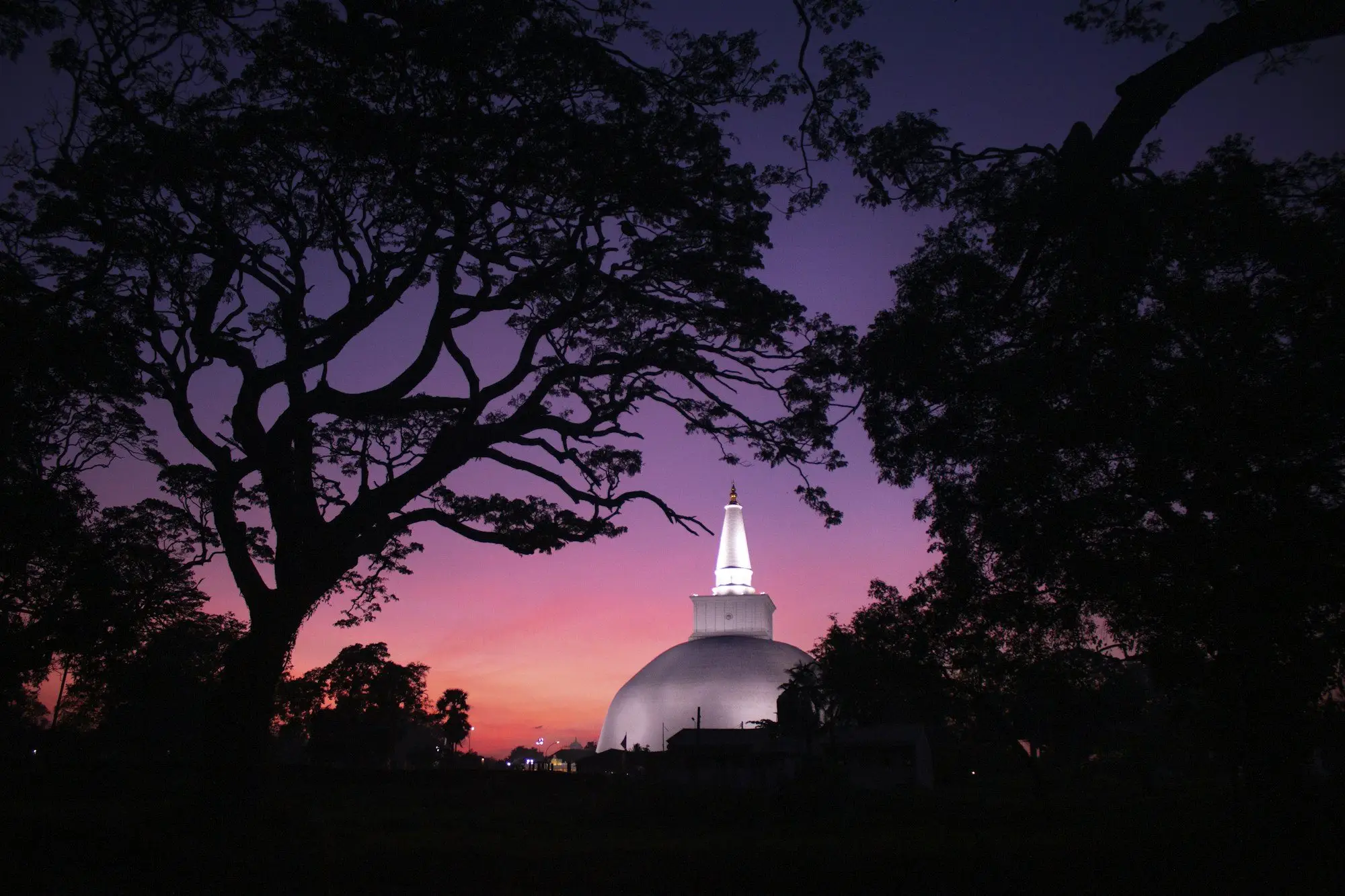

Anuradhapura Travel Guide: Ancient City & Wilpattu Safari
Cycle between Anuradhapura's giant stupas and the sacred Bodhi tree, then take the hour's drive to Wilpattu, Sri Lanka's biggest national park.
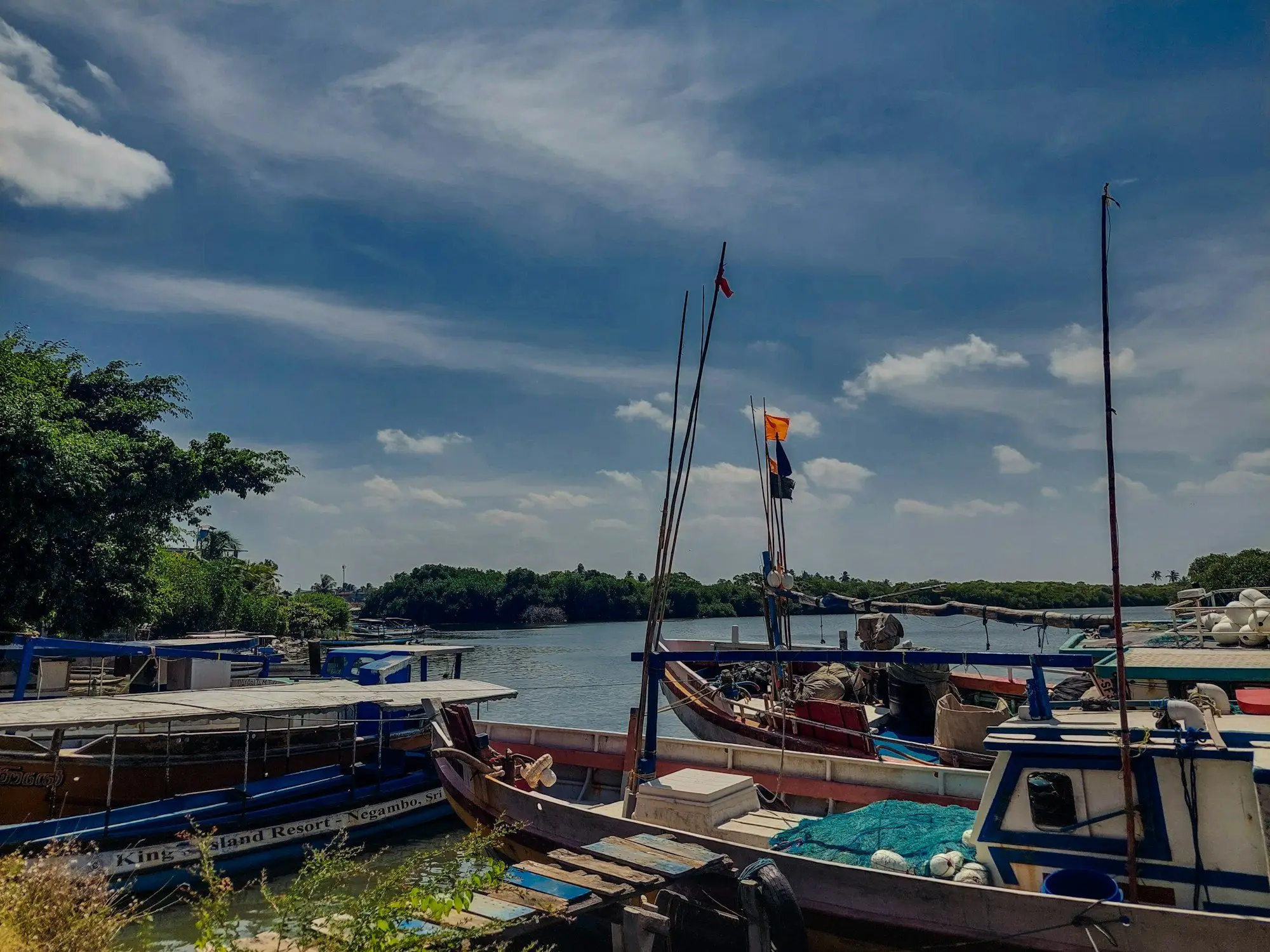

Negombo Travel Guide: Airport Town to Wilpattu Safari
Your first or last night near the airport: Negombo's lagoon, fish market and beach, plus how to start or end your trip with a Wilpattu safari.
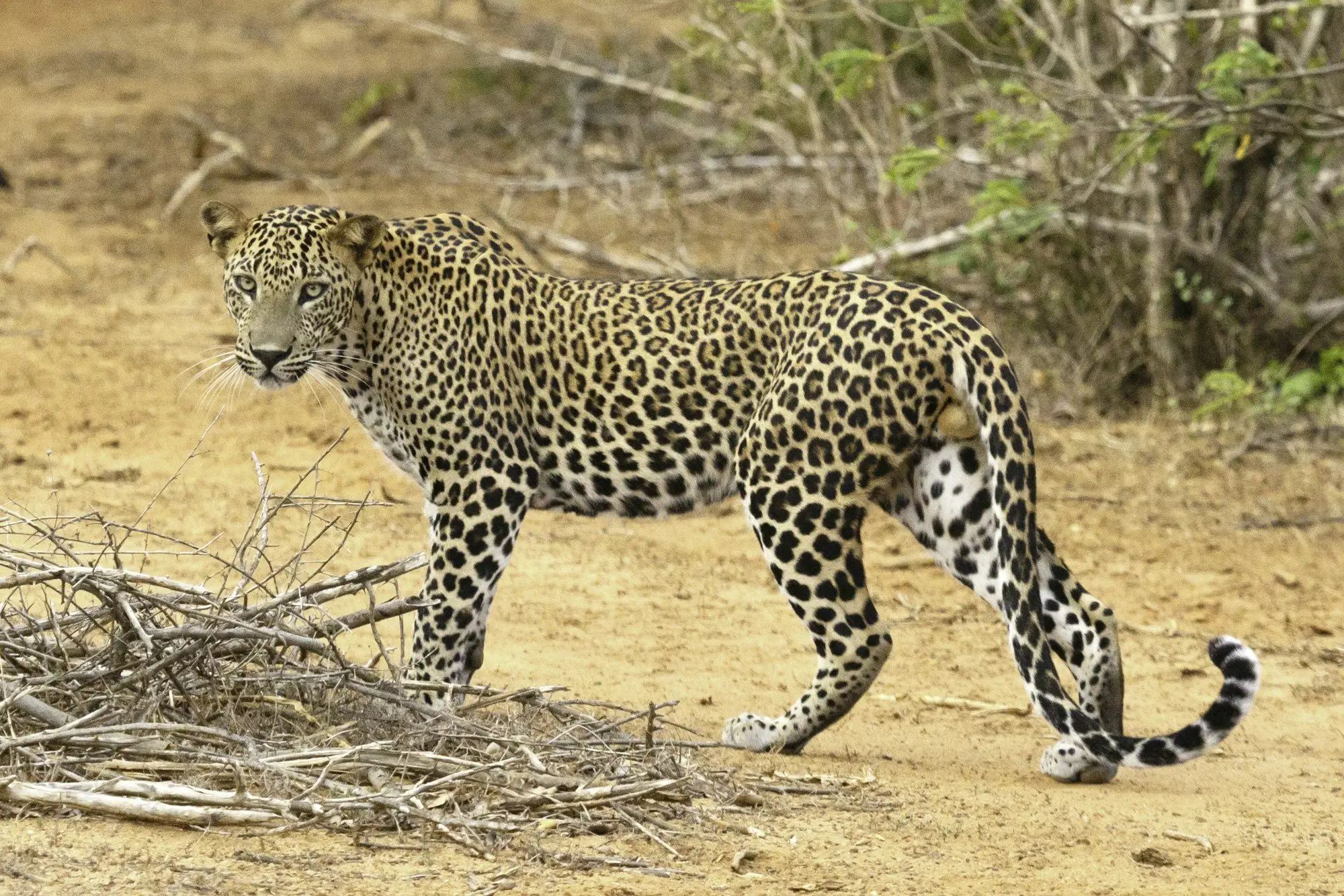

Yala National Park Guide: Leopards, Blocks & Best Time
Before your Yala safari: leopard odds, Block 1 vs Block 5, fees, safari timings, the usual Sep–Oct closure and how to avoid the jeep jams.